
Get Real ROI from Your Logistics Tech Stack
Discover how consolidating your logistics tech stack can streamline operations, reduce costs, and enhance efficiency with real-time data and no-code...
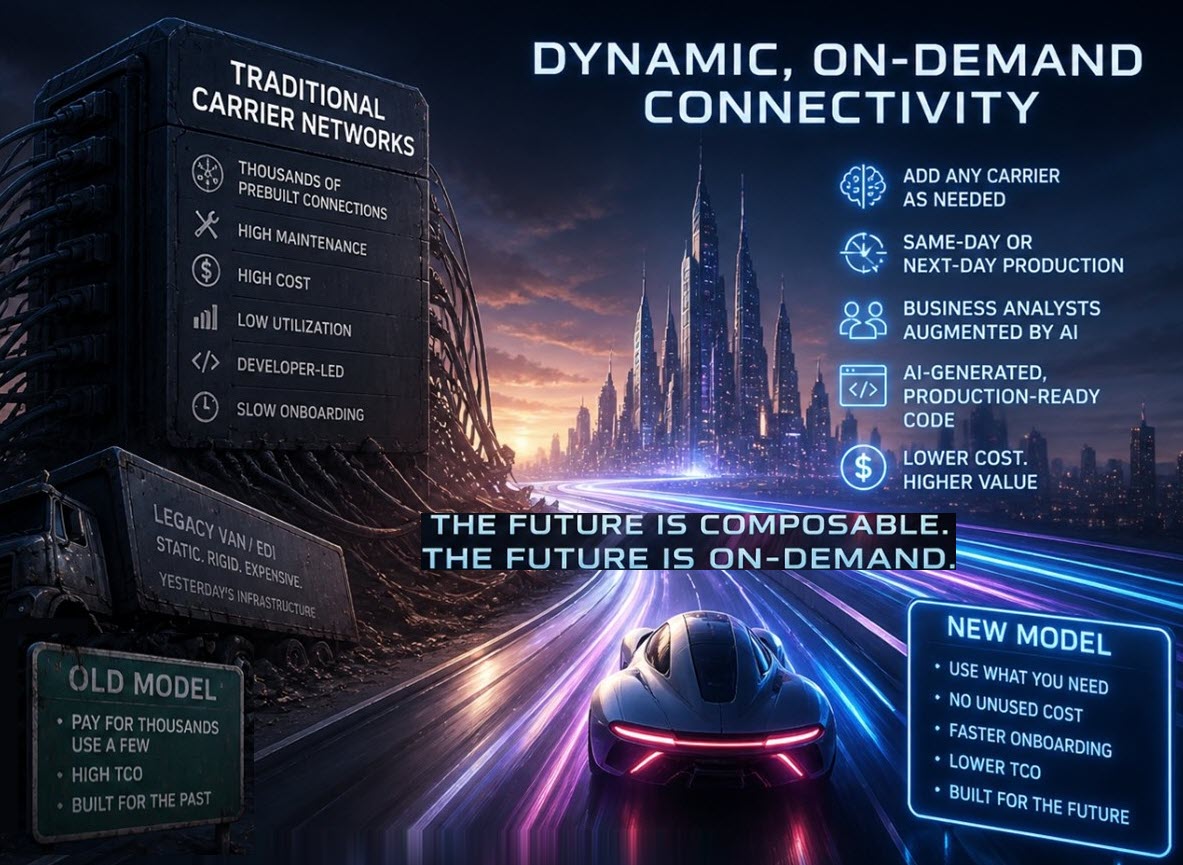
When carrier network platforms promote access to thousands—or even hundreds of thousands—of carriers, it’s worth unpacking what that really means from both a cost and architecture standpoint.
Each “connection” in a network comes with real overhead. It requires initial development (mapping, transformation logic, error handling), ongoing maintenance (schema changes, carrier updates), and operational support. At scale, that becomes thousands—even millions—of individual integration touchpoints that must be built and maintained over time.
That cost doesn’t disappear. It’s embedded in the network’s pricing model.
The more important question is utilization. Shippers don’t use thousands of carriers. They typically rely on a few dozen.
With a traditional network model, you’re paying for:
And despite all the standardization and connectivity that a carrier network brings, each carrier you actually work with still requires configuration, testing, and operationalization. This is a logistics network—not a general business network. Unlike fintech or standard order data, logistics operational data requires real normalization, and getting each connection production-ready still demands developer resources. It’s not the “flip-the-switch” experience their marketing suggests.
Our model takes a different approach. Instead of maintaining a large, static network, we focus on dynamic connectivity—enabling integrations with the carriers you actually use, when you need them. Our AI-backed platform generates deterministic, production-ready code on demand.
Just as importantly, onboarding is driven by business analysts, augmented with AI—not developers. Connecting a carrier becomes a business process—similar to adding the carrier to your TMS. In practice, it’s often less complex than setting up a routing guide or tariff.
While the onboarding steps still exist in our model, the execution is fundamentally different—faster, more flexible, and significantly more efficient, all handled by your operations team. Your logistics subject matter experts become citizen integrators.
ERP-based carrier networks, given the structure and strength of their ecosystems, are different. These networks rely on a model where carriers are responsible for self-connecting. While this reduces network developer costs, it largely shifts the connectivity burden to the carrier without simplifying the process. The result is the same complexity—just shifted—this is why many carriers struggle with onboarding to ERP networks.
For ERP networks to become more competitive—and to address the challenges carriers face in onboarding—they will need to adopt a citizen integrator model, where analysts, augmented by AI, can onboard and manage connectivity without relying on developer cycles.
Stand-alone third-party networks will struggle to survive while ERP networks will grow, even if slowly. The cost model for stand-alone networks is increasingly difficult to justify.
Why pay for a network when you can add any carrier on demand—faster and without developers?
Carrier networks are essentially a continuation of an older model: large, centralized bundles of prebuilt connections. They are similar in many ways to legacy VANs.
The economics challenge is straightforward. Paying for access to thousands of carriers when you only need a few dozen doesn’t align with how modern systems are designed or consumed.
Dynamic, on-demand connectivity is where the market must move—because shippers/3PLs/LSPs need integration agility at lower costs. Billions have been invested in building these networks, and these platforms are not going to give up that model easily. They will continue to push that narrative and put lipstick on it to justify those sunk costs.
But the underlying shift is already happening. Modern tools and AI have fundamentally changed the model. Large, static carrier networks aren’t the future—they’re last generation’s infrastructure still trying to prove it belongs.