Transportation Event Data: What TMS & AI Need From Carrier Integrations
Learn why TMS and AI systems need complete transportation event data, a shipper-defined event SOP, and coverage across EDI, APIs, and webhooks.
Across conversations we have had with forward-thinking CTOs in the logistics and supply chain space, a consistent theme keeps emerging. Regardless of company size or technical maturity, the same two observations surface when discussing integration projects.
Those two points explain why so many integration initiatives struggle with cost, timelines, or just fail.
API and EDI projects are often framed as technical challenges: connecting endpoints, handling authentication, managing payloads, or standing up message flows. That framing naturally pushes ownership to development teams.
In practice, however, that is not where the effort goes.
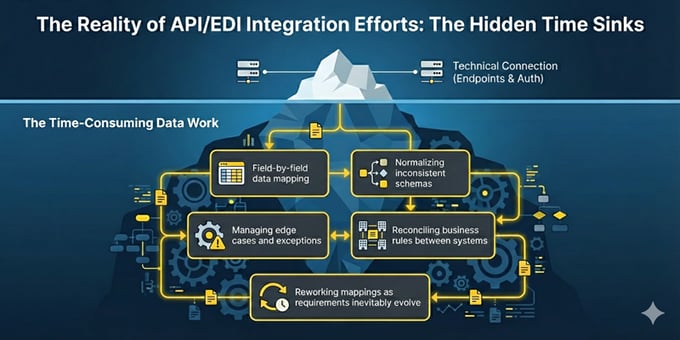
The majority of the time spent on API and EDI integration projects is consumed by these tasks
Connecting to an API or EDI endpoint is rarely the most difficult part of the project. Understanding what each field represents, how it should be transformed, and how to keep that maintain the integration over time are the real project blockers. These tasks are tedious and ongoing.
One of the most consistent points we hear from forward-thinking CTOs is a clear desire to keep development teams out of data-mapping work.
Not because the work is unimportant, but because it is the wrong use of highly skilled engineering talent.
Development resources are best suited for:
When those same teams are pulled into repetitive mapping and transformation tasks, two predictable outcomes follow:
“Integration projects quietly become a tax on the organization rather than an accelerator.”
The shift we see successful organizations making is recognizing that API and EDI integrations are fundamentally data problems, not software engineering problems.
Integration projects require:
When integration projects are approached this way, development teams stay focused on high-value work, and integrations become faster, cheaper, and easier to manage at scale.
If your integration strategy depends on developers manually mapping fields, writing glue code, and maintaining one-off API or EDI connections, you are overpaying while slowing the business down.
It is a subtle change in mindset—but one that has a meaningful impact on speed, cost, and scalability. It is also why we say that with 1Logtech, integrations are configured, not coded.